Tuesday, July 27. 2010
Good video summary of the American aircraft carrier. Most of our readers probably know it all, already.
Monday, July 26. 2010
As I always do before trips, I am catching up on history. This trip will be Vienna and the Danube. I view these places historically as the hinterlands, but you cannot fault their production of music in recent centuries. Music, wars, and sort-of hideous baroque architecture.
Vienna had been a Roman frontier outpost, but surely had been a barbarian settlement before that.
I do recall that European History in high school made my head spin from the endless alliances and endless wars and the reconfigurations of empires, kingdoms, duchies, principalities, and nations. With my ADD, it's a wonder I did so well with it. Forgot most of it. The War of the Spanish Succession.
I did not forget some details of the devastating Franco-Prussian War, but I certainly had forgotten that "German Austria" wanted to be part of Germany after WW1, but the Treaty of Versailles and the League of Nations forbade it. German Austria reached down into the (still) German-speaking areas of northern Italy. The Austria of today is a relatively brand-new nation (1945 or 1955 - pick the date) although it was a Babenburg duchy in 1156 and later was roughly the core of the Hapsburg's power for 640 years.
The Hapsburgs are credited with keeping the Ottomans out of Europe in 1683, but the King of Poland, Jan Sobieski, deserves lots of credit. There were 300 years of resisting the Ottoman Empire's invasions. I have never understood why Middle-Easterners coveted Europe, but they still do.
I find it amusing to think of what was going on in the wilds of the American colonies at the same time. Only Spain really cared, because of the gold. Otherwise insignificant except as pawns in larger European power games.
In the early 1700s, the Hapsburgs counted among their imperial control Belgium, Sardinia, Corsica, the Duchy of Milan, Naples, and Sicily. Two hundred years earlier, HRE "Emperor" Charles V in 1516 also happened to be King of Spain, bringing Spanish America, for a while, into the bounds of the Holy Roman Empire - such as it was: A crown, a flag, a bunch of castles and palaces, a title, and some truly snazzy outfits with fancy medals on them to impress the gals. Being King of Spain, on the other hand, was probably a cool gig with plenty of perks and babes.
The modern European nations are all younger in their configurations and their governmental structures than the US (except for the post-Empire island core of Britain).
One thought this perspective gave me is that the EU may be little more than an expanded reconstitution of the Holy Roman Empire - combined with the old Roman Empire. In time, it will pass too.
Photo below, Palace Schoenbrunn, first constructed as a hunting lodge in the early 1700s. "Hey, honey, have you seen where I put my camo and my ammo?"
That's from a time when royal governments lived off the labor of the people. Not like now, right?

Sunday, July 25. 2010
While feasting on late after-dinner hazelnut gelati a little over a week ago in the relatively non-touristy lakefront village of Baveno, just up from the small piazza on the main drag, we were drawn to the sounds of a church choir, and sat on the stoop of the side door of the sanctuary for a half hour listening to them practice as darkness fell.
Nothing can make a 20-person choir sound like the Mormon Tabernacle Choir the way a small stone 900 year-old church can. Excellent group, too, with an exuberant organist.
Saint Gervaso is the patron saint of Baveno. Like many old buldings in Italy, the church was built of stone previously used in Roman buildings, some still bearing Roman markings and lettering. Recycling. We noted that they never took stones from the Roman bridges or aqueducts, though. Smart - and a conservative message.
This is no famous church, just an ordinary village church. Clearly pre-Gothic. The church and tower were built in around 1100 (but the front of the sanctuary was expanded a bit since then), the Baptistery in 1628, and the open hall of the Stations of the Cross probably in the 1700s, when Baveno became wealthy from its quarries of pink marble (which are still in use).
Palm trees right up there near the Swiss border.

More photos of this small, unknown parish church below -
Continue reading "Santi Gervaso e Protaso: a re-post from 2008"
Wednesday, July 21. 2010
From Classical:
I saw a study once that in the US in the 1700s about 1/3 of the brides were already knocked up...
You want to do something about Western morality? Forget gays. The bigger hole is adultery and divorce. If we could bring back stoning for adultery and 40 lashes for fornication we might get somewhere. It all started going bad long before women got the vote. But it didn't help.
Grim has a good site but he appears to lack permalinks. Scroll down for Let's Make Sex a Lot More Heartless
Breitbart's dirty trick? Maybe dirtier than he realized. Says Lowry:
... her full speech is heartfelt and moving. It's the tale of someone overcoming hatred and rancor when she had every reason not to.
Sowell: Race Card Fraud
ADHD and marriage
What is being sold here?
Tenure is dying
Afghanistan 113 years ago
Pethokoukis: Just how high would taxes need to go?
Rabbi Shmuley: No Holds Barred: What's up with Tom Friedman?
Tiger: Health care "reform": What if the individual mandate is unconstitutional?
Are unemployment checks turning into welfare? Next step, permanent unemployment checks.
Political snobbery
Hungary's IMF revolt augurs ill for Greece (h/t EU Ref)
JournoList Members Discussed Whether the Government Should Shut Down Fox News. It's an ugly story. At Powerline, The Vast Left-Wing Journalists' Conspiracy
MAYBE we should hire the guys who run Wal-Mart to fix the economy.
Monday, July 19. 2010
It's fun to put history in context. A good piece on phlogiston theory.
One quote:
The Phlogistians were not a bunch of cranks. They were serious scientists who helped resolve some of the basic questions of chemistry, by being the devil's advocate against the Antiphlogistians, and by discovering important experiments. And, for almost the entire 18th century, the phlogiston theory was more satisfying than the alternative, in some ways. The Antiphlogistians deduced that combustion was when a substance combined with oxygen (Priestley's dephlogisticated air). But, they could not tell why substances combined with oxygen, or even why all substances didn't just burn up. Phlogiston theory explained why, because some substances were rich in phlogiston, and burned. It was only later that more satisfactory explanations were discovered.
Saturday, July 17. 2010

A quote from "Harnessing the Earthworm" by Dr. Thomas J. Barrett, Humphries, 1947, with an Introduction by Eve Balfour; Wedgewood Press, Boston, 1959:
For more than sixty years these 160 acres had been farmed without a single crop failure. My grandfather was known far and wide for the unequalled excellence of his corn and other grain, and a large part of his surplus was disposed of at top prices for seed purposes. The farm combined general farming and stock raising; my grandfather's hobby, for pleasure and profit, was the breeding and training of fine saddle horses and matched Hambletonian teams. He maintained a herd of about fifty horses, including stud, brood mares, and colts in all stages of development. In addition to horses, he had cattle, sheep, hogs, and a variety of fowl, including a flock of about five hundred chickens which had the run of the barnyard,with a flock of ducks. Usually about three hundred head of stock were wintered. The hired help consisted of three or four men, according to the season, with additional help at rush seasons. This establishment was maintained in prosperity and plenty, and my grandfather attributed his unvarying success as a farmer to his utilization of earthworms in maintaining and rebuilding the fertility of the soil in an unbroken cycle. The heart of the farming technique was the compost pit.
It takes you back in time. Read the whole essay, My Grandfather's Earthworm Farm
Sunday, July 11. 2010
Thanks to a reader for pointing out this remarkable piece by Woodrow Wilson, Socialism and Democracy. A brief sample:
In face of such circumstances, must not government lay aside all timid scruple and boldly make itself an agency for social reform as well as for political control?
'Yes,' says the democrat, 'perhaps it must."
Wilson's short essay, in which he claims that democracy and socialism are inseparable, is certainly relevant to Kesler's Friday post, Demonization Does You In.
A discussion of Wilson's progressivism here.
Ed. comment: Interesting. It is an antique view of the world, indeed. I believe Wilson wrote that blog post essay in the 1880s. As we always ask here, 1. What about freedom? and, 2. Where's the money and wealth gonna come from? I am with CS Lewis, who preferred that people aspire to wealth than to power if they must aspire to worldly goals. Wealth is harmless, and often beneficial. Power is scarey.
Double addendum, Goldberg via Driscoll:
...it is my argument that American liberalism is a totalitarian political religion, but not necessarily an Orwellian one. It is nice, not brutal. Nannying, not bullying. But it is definitely totalitarian–or ‘holistic,’ if you prefer–in that liberalism today sees no realm of human life that is beyond political significance, from what you eat to what you smoke to what you say. Sex is political. Food is political. Sports, entertainment, your inner motives and outer appearance, all have political salience for liberal fascists.
If politicians had more common sense than my plumber or Tom Jefferson, it might almost be a debatable argument. One which Aristotle settled long ago, however.
Saturday, July 10. 2010
Accountants know who he was. He was a pal of Leonardo, and the inventor of double-entry bookkeeping.
He wrote treatises on chess, math, and other things too. Imagine what sort of website he could have had, had he only invented the intertunnels too. Everybody knows that Sippican invented the intertunnels.
Double entry sounds like tax cheating, but it is not. It is about credits and debits. (It does not refer to the private, personal books for cash receipts that many unscupulous Lefties use to dodge Uncle Sam and rip off their neighbors.)
Image is Luca Pacioli, b. c. 1445.
Wednesday, July 7. 2010
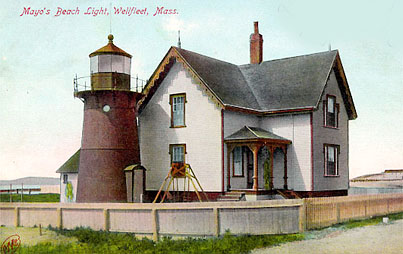
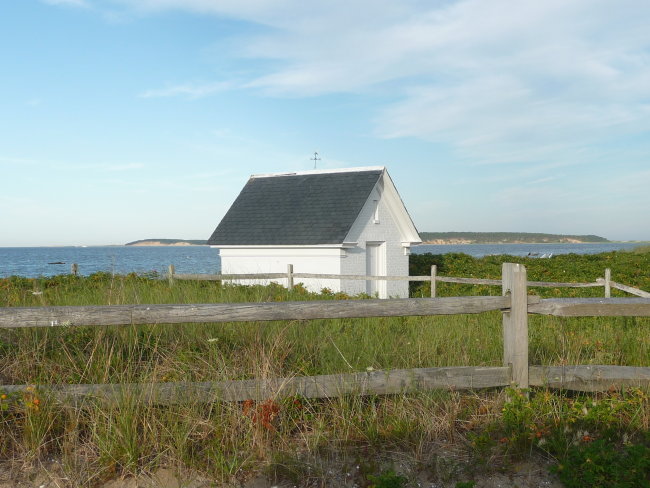
Here is the lighthouse-keeper's house today (the Coast Guard moved the light itself to California):

This little brick structure in the back contained the kerosene, delivered by boat as needed, to keep Mayo Light burning to mark Wellfleet Harbor:

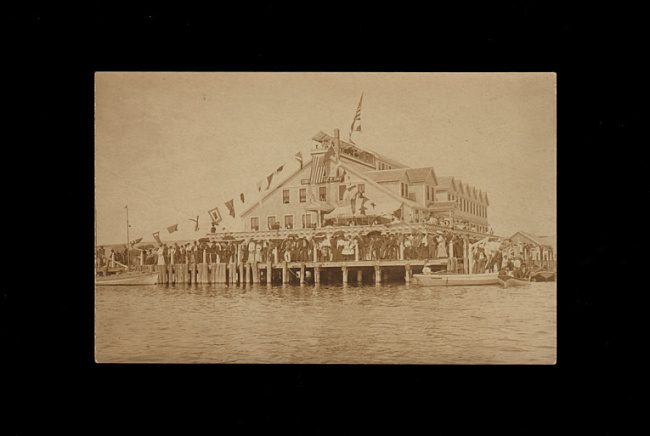
Just past Mayo Beach, through the 1920s, was the grand Chequessett Inn, built on pilings (the stumps of which still poke through the mud) and finally destroyed by an attack of sea ice in the 1930s. Rumor is that rum-runner boats would stop by at night, contributing to the Inn's popularity during Prohibition.
It was built by Mr. Lorenzo Dow Baker, the pioneer of the banana trade from the Caribbean and Central America. On a whim, he loaded his schooner's empty hold with tropical fruit for the return trip to Boston, and made millions. Mainly bananas, hitherto unknown in Boston. Ended up owning plantations all over Central America, and a big hotel in Jamaica. His employees were Jamaicans: They worked Wellfleet in the summer and the Jamaica hotel in the winter.
Baker's business became the Boston Fruit Company, the foundation of the United Fruit Company. A clever Yankee.

Thursday, July 1. 2010
A great resource for those driving around New England this summer: Historic Houses of New England -open to the public.
Paul Revere's house below:
Sunday, June 27. 2010
Breaking eggs. From Anne Applebaum in her review of Children of the Gulag, quoting Lenin's wife (h/t Samiz):
"We are building socialism ... and as long as we are building socialism but have not yet built it, we will also have homeless children."
Friday, June 25. 2010
At the doctor’s office this morning I picked up a magazine, Biblical Archaeology Review, of course dated November/December 2009.
An article caught my eye, How Did Israel Become A People?, by Abraham Faust, based on his book (hold on for a doozy of a title) Israel’s Ethnogenesis: Settlement, Interaction, Expansion and Resistance (2007) which won the Biblical Archaeology Society Award for Best Scholarly Book on Archaeology.
Briefly:
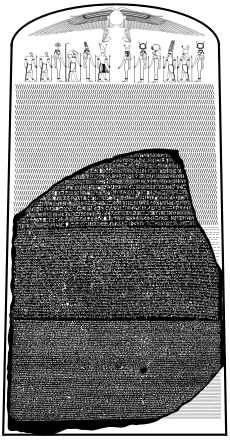
The “Israel” that is mentioned in the Merneptah Stele [13th Century B.C.E.] is indeed the “Israel” of the Iron Age. And it can be identified archaeologically. The rich archaeological database, and its analysis with appropriate tools, allows us to trace the Israelites and to decipher many of the internal and external processes that characterized the group from the beginning of the Iron Age onward.
So much for arguments about Jews being a recently externally imposed colony on historically Arab land. The peoples in Israel at the time of the 13th Century B.C.E. were Israelites, Canaanites, long gone, and then Philistines, from elsewhere in the Mediterranean, with some Egyptian invaders for a time in between.
Faust promises another article about the development of Israel’s Jewish religion.
I’m going to be returning to the website of Biblical Archaeology Review, as there appear to be many interesting, scholarly articles and book reviews from various religious and academic viewpoints.
Wednesday, June 16. 2010
John Wesley (1703-1791), founder of what we now call Methodism (the term was originally used as an insult but was eventually adopted by Wesley), and his brother Charles spent some time in Savannah, GA. I lost a bet about that at a dinner party last year, which cost me a bottle of good Montrachet.
Methodism was the ultimate source of our 12-step programs: the Wesleyans liked to have methods for spiritual discipline. John Wesley was an evangelist, and liked to preach outdoors. He tried to convert the Georgia Indians.
He was a "by faith alone" preacher.
He got in a bit of a problem with a Georgia lady, and eventually returned to England. Here's a piece on Wesley in Georgia, and here's a Wesley bio.
The hymns written by John and Charles Welsey are among my favorites. Charles wrote 6000 hymns. John even produced a hymnal but, as this site notes,
Today people are much more familiar with some of Charles Wesley's hymns than with John Wesley's sermons.
Image of John Wesley above, Charles Wesley below:

Monday, June 14. 2010
An American GI has been exploring the caves of Okinawa since 1966.
Sunday, June 13. 2010
A re-post -
The Greeks colonized Poseidonia - now Paestum - on the south-west coast of Italy (90 miles south of Napoli) around 650 BC. Poseidonia became the Roman city Paestum in 273 BC.
Paestum contains the finest complex of Greek temples in the world, which was discovered in 1762 by a road crew. They were built before the Parthenon was completed in the 400s (BC).
The modern town of Paestum is a seaside resort, but the reason to go there is to see the Greek temples outside of town. Our Dylanologist did just that (and brought me back a Paestum t-shirt!).
The splendid, if heavy-looking, Doric temple in this photo is known as The Temple of Hera ll.
Here's a photo of the 450 BC Temple of Hera l, later rededicated to Neptune. More info on the Hera l temple here.
Here's a photo bank of the contents of the Paestum Archaeological Museum.
A bit of commentary from the Great Buildings Online website:
When the ruins of Paestum were 'rediscovered' by 'antiquaries'—chiefly Johann Joachim Winckelmann—in the 1750s, "the ruins [were] then made widely known, and an enthusiastic appreciation of Greek art and architecture was also sparked...Because of Paestum, the Classic Revival was born with Greece, not Rome, ascendant."
— Deborah Fritz from G. E. Kidder Smith. Looking at Architecture. p16.
The three Paestum temples are all in the Archaic Doric style of heavy columns with capitals that are squat, or as Goethe termed them, 'oppressive.' By the time the Parthenon was finished (438 B.C.), columns were elegantly slender, capitals had an alert, load-bearing profile, and refinement attended every detail. Moreover, they were carved from Parian marble; Paestum's now crudely exposed shellstone shafts, it is only fair to say, were originally covered with lime stucco. As in Greece proper, the temples at Paestum face easterly so that the rising sun will awaken the statue within."
— G. E. Kidder Smith. Looking at Architecture. p16.
Thursday, June 10. 2010
Good place to stop when passing through Reading, PA: The Mid-Atlantic Air Museum.

Sunday, June 6. 2010
In 1973, Nixon and Kissinger used South Vietnam as a tool to widen the split between China and the Soviet Union. In 2010, Islamists, Iran and other Muslim states use the Obama administration as a tool to split the US from Israel.
Most of us who are still aghast at the Democrat controlled US Congress dooming South Vietnam to fall by cutting off promised arms and air support necessary to its survival also criticized Nixon and Kissinger for walking into the duplicitous trap of the Peace Accords of 1973. The North Vietnamese rulers had a long, documented history of promising one thing while doing another.
However, Nixon and Kissinger had a bigger game afoot, to reduce tensions with China for our purpose of widening its rift from the Soviet Union, which added pressure on the Soviet Union.
In effect, South Vietnam was a tool to what they had good reasons to believe was a bigger, more important end. Surely, neither Nixon nor Kissinger expected Nixon’s Watergate downfall and the left Democrats to sweep to Congressional power.
There’s a difference now.
Obama and Clinton may be thinking they are using Israel as a tool to cuddle up to long and continually intransigent Arab states. But they are actually tools themselves of those who seek nothing else than the downfall of Israel and the retreat of the US from confronting their clear goals of dominating the Middle East and, via its oil, Europe.
Obama and Clinton don’t deny the ongoing efforts of Iran in going nuclear or sending men and arms to those attacking US, Iraqi and Afghan troops, to Syria, Lebanon and Gaza. They just avoid the necessary countermeasures and march forward in repeatedly proven delusions of Iran changing its spots and of kumbaya as a replacement for reality.
Nixon and Kissinger had a world view realistically based on US interests furthering a world order of surer peace. Obama and Clinton, fully consciously or not, have a world view based on US interests being a barrier to a world order of peace, that ignores or excuses or refuses to confront the reality of foes’ unrelenting hate of the US and the West, encouraged by Obamanesque fecklessness.
Oh! Another bit of reality that Obama and apologists can try to ignore: "Iran Revolutionary Guards ready to escort Gaza ships"
- Thanks again, Insty. We appreciate your appreciation, and encourage Insty folks to peruse our eclectic site. You might like it. Or you might not.
P.S.: Hillary Clinton warns Iran not to pull a stunt. Wake up Hillary, "Iran called our bluff long ago."
Saturday, May 29. 2010
David Brooks wrote a much-linked piece on the two enlightenments last week. Far better and more amusing is this ripping apart of Brooks' essay. It's tough to get away with BS in the internet era.
That is quite correct that there was no "British Enlightenment." Here's our post, with a good link, on the Scottish Enlightenment.
And another good one: How The Scots Invented The Modern World
Sunday, May 2. 2010
A small island group near the coast of mainland China, Quemoy, gave us lessons that we need to remember in dealing with Iran. There cannot be an analogy between geographies, actors, and the times. But lessons can be insightful to current circumstances of the primacy of recognizing US interests, the difference between friends and foes, and acting accordingly or failing through dithering and fecklessness.
Few remember the history shaping role in the 1950s of Quemoy.
The defense of Quemoy by Nationalist forces against an invasion from newly Communist China in 1949 effectively stymied mainland China’s objective to take Taiwan and, in the face of world defeatism, demonstrated that the Asian march of communism could be defeated.
The same mistaken line drawn by the Truman Administration placed South Korea and the Taiwan Straits outside the US containment perimeter. This encouraged the Soviet and Chinese support of North Korea’s invasion of the South in 1950.
Preoccupied in Korea, and following an inclination toward stalemate being enough for containment, the US 7th Fleet patrolled the Taiwan Strait to prevent either Communist China or Chang Kai-shek’s rump in Taiwan from attacking the other.
In 1953, President Eisenhower, though believing Quemoy to be indefensible and believing the French position in IndoChina would not hold, allowed Taiwan to heavily reinforce Quemoy, raising the threat level to distract and deter China.
In 1954, however, the Chinese, not to appear deterred, unleashed thousands of artillery strikes upon Quemoy, took another small island over 200 miles north of Taiwan, and skirmishing occurred along and on China’s coast.
Continue reading "Lessons Of Quemoy For Today"
Thursday, April 29. 2010
Thirty-five years ago, South Vietnam fell to the communist North. Twenty-eight years ago, President Reagan addressed the British Parliament at Westminster in his famous “Ash Heap of History” speech, to where tyrants will be sent by those valiantly defending freedom.
Yesterday, I went to Orange County’s “Little Saigon”, Westminster, to attend a forum marking the 35th anniversary of the fall.

Before the forum, attendees went outside in the Sid Greenstein Freedom Park for a minute of silence before the war memorial there, the only one in the US honoring US and Vietnamese who fought together.

I knew three of the speakers well (and two others less from shared personal experiences, more as acquaintances, but major figures) from many years of collaboration and friendship to not let the Vietnamese and American sacrifices be in vain, to educate new generations in the lessons personally witnessed and learned...
Continue reading "A Tale Of Two Westminsters: 28 and 35 Years Later"
Wednesday, April 21. 2010
Human culture developed during the past 50,000 years, despite homo sapiens being around for much longer (300-400,000 years).
One theory is that certain rapid climate changes during the most recent glaciation phase, known as the Dansgaard-Oeschger events, are what prompted the development of complex cultures.
Adaptability is a human strength. The Bug Community seems pretty good at that too.
Sunday, April 11. 2010
A re-post from June, 2008. Was it that long ago? Seems like yesterday...It was a fine trip.
We took a day, last week, to hop the train over to Lake Como (and to stop by the Como Duomo), and took the fast ferry up to Villa Carlotta in Tremezzo - and then across the lake to Bellagio to see the equally renowned gardens of Villa Melzi.
The 17th-18th century Villa Carlotta and its gardens were a traditional and necessary stop on the "Grand Tour" of "the Continent." We anglophiles like to follow in those old paths.
It is impossible to capture on camera the feel of such vast and varied gardens, which are, in effect, both botanical gardens with worldwide collections of plants, and ornamental gardens designed to impress as much as to delight - some formal Italian and some English-style.
For example, these gardens have bamboo groves, Sequoia groves, acre-sized plantings of azalea, palm collections, collections of cacti, citrus arbors, etc. Even a turtle pool with happy and smiling American southern Red-eared Sliders and Cooters.
This photo is the entrance:

More of my mediocre photos on continuation page below -
Continue reading "Villa Carlotta"
Tuesday, April 6. 2010
"Professor Arkes discussed the Four Horsemen, four conservative justices on the Court during the 1930s who tried to block many of President Roosevelt's New Deal programs. He examined many of the Supreme Court cases from the Roosevelt era."
Those four guys saved us. Says the Prof: "We are the beneficiaries of the world that Sutherland and colleagues preserved for us."
Video from 1996. (h/t, No Left Turns)
Friday, March 12. 2010
Founder of the American Red Cross Nursing Service. It's her birthday.
She said she didn't do it because she was moved by suffering, but because she liked the work.
I prefer people who do fine things because they want to, not because of pious self-congratulatory virtue or grandiose notions of changing the world.
Tuesday, March 9. 2010
Alas, the man's name does a disservice to the brilliant Florentine Renaissance political scientist and student of human nature that he was.
However, I did not know that he wrote comedy on the side. Another Renaissance Man, as it were.
I like his face: shrewd and discerning, but ready to laugh.
"Princes and governments are far more dangerous than the other elements within society.”
- Niccolo Machiavelli
Sunday, March 7. 2010
I tend to think we still live in a Greco-Roman civilization. This from George Mason Prof Steven Davies:
Wednesday, March 3. 2010
It's an 11,500 year-old temple in southeastern Turkey. h/t to a good piece at Protein.

Thursday, February 25. 2010
Few of our readers recall tunneling to the barn during the big New England nor'easter blizzard of March 11, 1888.
Here's the weather story of that snowstorm (which tragically omits the role of AGW - we should never let an ancient weather crisis go to waste).
Some photos:
Longacre Square, NYC (Now Times Square):

Somewhere in Manhattan:

Somewhere in Brooklyn:

Main St., Stamford, CT, from this Stamford history site with more photos:

Train tracks in Norwalk, CT:

Sunday, February 21. 2010
William Tyndale was the Oxford-educated polyglot theologian and reformer who produced the first printed Bible in English.
His translation was from Erasmus' Greek-Latin Bible, the same one which Luther used to translate his German Bible. Tyndale's Bible was banned in Britain: you can't trust the rabble to read it themselves. He famously said that he wanted a Bible that "every plowman" could read the Scripture for himself.
Tyndale was executed by Henry Vlll for his efforts. It is believed that Thomas More was pushing for the execution.
It is thought that up to 80% of the King James Bible - the most printed book in the world - is Tyndale's product. For hundreds of years after the first printings, Protestants avoided the Anglican King James Bible, preferring the Geneva Bible (which is very similar). The Pilgrims used the Geneva Bible and, no, Anglicans are not historically Protestants and neither are their American Episcopalian brethren.
Excellent summary of the history of the Bible in English here.
Thursday, February 18. 2010
December 7, 1941. The Pacific Clipper, Queen of Pan American Airways fleet of flying boats is 6 days out of San Francisco, bound for Auckland, New Zealand. Captain Robert Ford receives a coded message: Japanese attack Pearl Harbor...Implement War Plan A...Proceed to Auckland, NZ...Maintain radio silence...Wait for instructions...Your aircraft is a strategic resource-it must not fall into enemy hands under any circumstances
Pan American Airways bases all across the Pacific were captured. Returning to the US west coast by the Pacific Clipper did not seem possible. A week of waiting, then another coded message:
DEC 14, 1941: Do not return to Hawaii. Do not return to US west coast...Strip aircraft of all markings and identification...proceed west...maintain radio silence...deliver aircraft to Marine Terminal, LaGuardia, NY. Good luck.
Tuesday, February 16. 2010

You probably already knew that the so-called Sphinx had been deeply eroded by rain from when the Sahara was wet, that the Sphinx has been buried under sand through most of its lifetime, and that the face is likely not the original. What I did not know is that the body of the sculpture was not constructed, but rather carved out of a single piece of limestone in the middle of a quarry.
Good update at Smithsonian.
Thursday, February 11. 2010
As Mrs. BD quips, "Lorenzo was sort of a Renaissance Man, wasn't he?" Lorenzo took an active role in designing the Villa Medici in Poggio a Caiano, 12 miles north of Florence, in 1485.
The design of this rural Medici farming villa, which so much impressed and influenced Palladio, was revolutionary in several ways, not the least of which were its orientation outwards rather than towards an inner courtyard and its lack of defensive fortifications. (Lorenzo was famously casual about security.)

Sunday, February 7. 2010
I do not know how many of Lorenzo di Medici's country villas are extant, but he helped design a few of them, one of which was an architectural inspiration for Palladio.
This one, sitting on the hills overlooking Florence, was built by Cosimo for his second grandson Giovanni, and came into Lorenzo's hands after his brother was assassinated by a cabal which included the Pope. It became one of Lorenzo's favorite hangouts with his philosopher, artist, and poet pals (and girlfriends).
(By the way, we recommend staying in Fiesole when visiting Florence, and it's just a 15-minute bus ride down the hill. November and May are good months.)


Saturday, February 6. 2010
In the (now, sadly, defunct) New York Sun:
Given the nearly total absence of fanfare, you could be excused for not knowing that this was the quincentenary of Andrea Palladio's birth. Generally it is a kind of condescension to treat the great cultural figures of the past as though, in some sense, they were, or needed to be, our contemporaries. And yet a respectable case could be made that, of all the architects who lived before the 20th century, few were as influential as Palladio (1508-80) or came closer, in the arc of their reputation, to being what we would now call a "starchitect."
Read the whole thing.
Here's Wiki on Palladio. Below is a photo of Villa Capra, aka Villa Rotunda, in Vicenza.
Thursday, January 28. 2010
We have it pretty good these days. From Gene Expression:
Geneticists have long known that the ancestors of modern humans numbered as few as 10,000 at some time in the last 100,000 years. The critically low number suggested that some catastrophe, like disease or climate change induced by a volcano, had brought humans close to the brink of extinction.
If the new estimate is correct, however, human population size has been small and fairly constant throughout most of the last million years, ruling out the need to look for a catastrophe.
Assuming an average census size on the order of 50,000, it seems as if our species stumbled onto a rather "risky" strategy of avoiding extinction. From what I recall conservation biologists start to worry about random stochastic events (e.g., a virulent disease) driving a species to extinction once its census size reaches 1,000. I suppose the fact that we were spread out over multiple continents would have mitigated the risk, but still.... It also brings me back to my post from yesterday, it seems that for most of human history we are a miserable species on the margins of extinction. For the past 10,000 years we were a miserable species. And now a substantial proportion of us are no long miserable (it seems life is actually much improved from pre-modern Malthusianism outside of Africa and South Asia). If only Leibniz could have seen it!
Friday, January 15. 2010
Part of an extraordinary long quote from A Woman in Berlin in a piece at Never Yet Melted:
...I long ago lost my childhood piety, so that God and the Beyond have become mere symbols and abstractions. Should I believe in progress? Yes, to biggger and better bombs. The happiness of the greater number? Yes, for Petka and his ilk. An idyll in a quiet corner? Sure, for people who comb the fringes of their rugs. Possessions, contentment?
I have to keep from laughing, homeless urban nomad that I am. Love? Lies trampled on the ground. And were it ever to rise again I would always be anxious, could never find true refuge, would never again dare hope for permanence.
Perhaps art, toiling away in the service of form? Yes, for those who have the calling, but I don’t. I’m just an ordinary laborer, I have to be satisfied with that. All I can do is touch my small circle and be a good friend. What’s left is just to wait for the end. Still the dark and amazing adventure of life is beckoning. I’ll stick around, out of curiosity and because I enjoy breathing and stretching my healthy limbs.
Wednesday, January 13. 2010
Identify the perpetrators of atrocities upon children as sociopaths or whatever (see Dr. Joy Bliss' post below), and the words don't come near the horrors they commit, which are monstrous, whether during the Holocaust or today in many countries.
Here's a photo from a group of 41 children, ages 3-13, plus ten adult staff the Nazis tore from their refuge near Lyon, France on April 6, 1944. The children were sent to Auschwitz and murdered, as were the staff.

Up to 1.5-million children were murdered in the death camps, about 1.2-million of them Jews, the others Roma or handicapped.
Holocaust by Barbara Sonek
We played, we laughed
we were loved.
We were ripped from the arms of our parents
and thrown into the fire.
We were nothing more than children.
We had a future.
We were going to be lawyers, rabbis, wives, teachers, mothers.
We had dreams, then we had no hope.
We were taken away in the dead of night
like cattle in cars, no air to breathe
smothering, crying, starving, dying.
Separated from the world
to be no more.
From the ashes, hear our plea
This atrocity to mankind can not happen again.
Remember us, for we were the children
whose dreams and lives were stolen away.
Here's a photo of a few of the very few children who survived to liberation.

We see similar photos today of children elsewhere in the world who suffer. Remember and do more than repeat the mantra "Never Again."
More info about the once happy children in the first photo at this site.
HT: My good friend "Charlite", a righteous Gentile.
Thursday, January 7. 2010
Jacob Burkhardt did. First Principles.

Sunday, January 3. 2010
Almost finished putting the Christmas stuff away, and amusing myself by refreshing my memory about Henry Hudson's voyages.
Given what a careful exploration he did, I am surprised he never ventured up the St. Lawrence, which Cartier had discovered in 1535 and which Champlain was exploring during the same time as Hudson's trip. Also, I am reminded that the English Jamestown settlement existed a couple of years before his Dutch-sponsored 1609 trip, and that the West Indies, South America, and even Peru had been settled by Spanish long before, in the 1500s.
The Spanish knew where the gold was, and it wasn't in New England.
Monday, December 28. 2009
Monday, December 21. 2009
Thursday, December 17. 2009
Tuesday, December 8. 2009
Two approaches to transitioning economies, by Gregory and Zhou at Hoover's Policy Review
Saturday, December 5. 2009

The Island at the Center of the World: The Epic Story of Dutch Manhattan and the Forgotten Colony that Shaped America, by Russell Shorto (2005).
A wonderful story. The Dutch colony of New Amsterdam, owned and run by the Dutch West India Company, was a quickly growing and boisterous commercial settlement of over 200 when the Pilgrims landed in Massachusetts. When the Dutch sent a friendly delegation up to Plymouth in 1624 or so with goodies and gifts of sugar, William Bradford sent a letter back with the delegation saying that he was sorry that he had nothing desirable to offer to return the favor.
On quote from the book re the Wickquasgeck Trail:
Broadway does not follow the precise course of the Indian trail, as some histories would have it. To follow the Wickquasgeck Trail today, one would take Broadway north from the Customs House, jog eastward along Park Row, then following the Bowery to 23rd St. From there, the trail snaked up the east side of the island. It crossed westward through the top of Central Park; the paths of Broadway and the Wickquasgeck Trail converge again at the top of the island. The trail continued into the Bronx: Route 9 follows it northward.
The Customs House was the site of the original Dutch fort to protect them from the Indians. The Lenape Indians turned out to be friendly to the Dutch (believing them to be potential allies against other tribes), so the fort was never well-maintained. Hence the Brits had no problem taking the town in 1664.
Today the Customs House is the home of the Museum of the American Indian. Worth a visit.
Related, years ago I read Beverly Swerling's City of Dreams: A Novel of Nieuw Amsterdam and Early Manhattan, which does a great job evoking the times - and the medical care of the times. Many would argue, I think, that NYC remains more of a Dutch heritage city than an English one.
Image: New Amsterdam, c. 1660
|