We are a commune of inquiring, skeptical, politically centrist, capitalist, anglophile, traditionalist New England Yankee humans, humanoids, and animals with many interests beyond and above politics. Each of us has had a high-school education (or GED), but all had ADD so didn't pay attention very well, especially the dogs. Each one of us does "try my best to be just like I am," and none of us enjoys working for others, including for Maggie, from whom we receive neither a nickel nor a dime. Freedom from nags, cranks, government, do-gooders, control-freaks and idiots is all that we ask for.
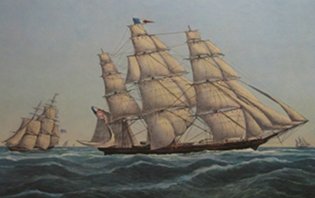
I love the traditional boating flag: The US Yacht Ensign. I'd like to see more of them around.
My Grandpa used the Power Squadron flag/ensign on his boats because he was some sort of official in it, but I am not. I think he used that on sailboats and on power boats, but not sure.
The Scottish Martin Walker is well-steeped in the life of the Perigord. Washington DC too, and the UK. One of those guys who has led an interesting life - and writes diverting books.
This 2020 nonfiction bestseller explores why people from Western societies
think and behave differently from the rest of the world. The title uses
WEIRD as an acronym for Western, Educated, Industrialized, Rich, and
Democratic.
It's a fat paperback, but readable in bits. Different cultures view reality and life very differently. There is a reason for tribalism.
Mike Rowe is always on this topic, but I have had two experiences lately related to this.
First, I have a clock repair shop that I use. Clocks, not watches. He told me that his current repair wait line is 2 years. His expertise and pleasure is antique (over 100) clocks, including grandfather clocks. He'd be glad to get two reliable and interested apprentices, but can't find them. His last one, who he felt had talent, stole from him so that was that.
(Tips for old clocks: Never overwind. Never move with pendulum attached. Only correct time forward, with minute hand only. And be aware: some old clocks rewind clockwise, some backwards)
Second, my firearm expert recently died. He had a firearm woodworker with him. I counted on their skill for all of my firearm glitches. He had tried for 5 years to recruit apprentices from the local high school with no response. He was plenty busy but wanted somebody to take his business over. It is gone.
Pine, spruce, hemlock, and fir make excellent firewood. With their pitch content, they may burn hotter and quicker than hardwoods, but they produce plenty of good heat and light. They produce no more chimney creosote than anything else, and probably less.
Firs and pines are most of what they burn out West.
While everybody needs to have a well-used chimney cleaned regularly, creosote accumulates in a chimney mainly from wood with high water content. In other words, "green wood" which has not had 6-12 months to shed its water content by sitting outdoors, or has not been "kiln-dried" like the expensive stuff in stores. Green pine wood is no more problematic than green maple, according to the experts. Ideally, give all wood some time to dry out to minimize creosote build-up.
A second cause of creosote build-up (we are not talking about ash build-up in the chimney, just the greasy creosote) is probably smoldering fires. The hotter the fire, the less likely that creosote will find time to condense and attach somewhere in your chimney. Creosote is, to some extent, water-soluble and thus condenses as it moves up to the cooler parts of the upper chimney.
The problem with creosote is chimney fires. Readers know that I've had a few, and it is not fun. If you are far from a fire station, it can burn your house down by either sparking the roof or penetrating the flue. People like me who burn wood indiscriminately - any wood from any tree, green or aged - must deal with the creosote issue with creosote fighters. Chimney sweeps cannot remove the grease, but chemicals can. I also enjoy quiety smoldering fires rather than dramatic blazes, so I do everything wrong.
Details on creosote oils here. Some creosote oils are what preserves and gives flavor to smoked meats. I remember painting fence posts with creosote as a lad, with my Dad. I don't think people do that anymore but it is a good and cheap wood preservative.
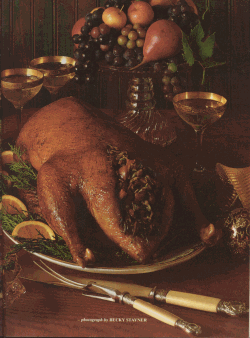
Christmas is a traditional feast day (but it was not for true puritan folk like Dutch Reform or Congregationalists, who did not historically care for Christmas), so you are expected to cook something tasty. We have done all of the things: turkey (again), goose, roast beef, crown roast of pork with apple stuffing (real good).
On the other hand, the southern Italians do a cool thing - they do the Christmas Eve fish dinner - because it is a vigilia di magro (fasting, Italian-style).That is darn good. Fried baccala, fried calamari, scungilli, clams, mussels, maybe lobster etc etc. I love the baccala, and those little fried minnows bagiggi - smelt - with lemon that you eat whole like french fries, and clams (if they aren't cooked), but hate those cold seafood salads - dolphin food. In Sicily, the tradition is seven fishes. Serious abstinence: cook a leg of lamb, and you burn in hell for eternity.
But back to Yankee Christmas dinner, and goose.
As regular readers know, we cook our Canada geese with the breast only, marinated and sauteed rare. We confit the legs and thighs.
Store-bought goose tends much smaller (maybe in Dickens' time they had bigger farm geese - if you can find a giant Christmas goose as big as Tiny Tim, great), and has lots more fat on it. In fact, it seems about 50% fat, which oozes out during cooking and fills the pan below. If you want to cook that traditional English bird, you need a few of them. I would say, one per 3-4 people, minimum, if you are using the supermarket birds. (Some might disagree with this.) One bird will not do it, as a turkey does, because once the fat melts off, there isn't much left except bones. The plus side of all of the fat is that they are self-basting.
This is a good approach. Overcooking a goose, at low heat, is not a bad idea. For a roast goose, you may really want the meat falling off the bone, unlike a nice rare breast of wild goose. Goose is, of course, a dark meat like duck (but more coarse in flavor, I think).
Make a tasty sauce out of the drippings, once you have removed the fat. Add a little red wine, maybe a handful of huckleberries or dried cranberries and a bit of sugar, and reduce/thicken.
What to serve with goose? Mainly braised and sauteed roots. Parsnip, carrot, potato, turnip. And how about a rutabaga puree? Or a celeriac (celery root) puree? Maybe a pile of braised, sauteed baby squash, too. Cranberry sauce? You bet.
Adventure generally refers to voluntary engagement in new things, especially things small or large, that might be somewhat daunting. Anything beyond emotional or physical comfort. Heart rate maybe.
I'll invite your views at the end of this, and my thoughts are far from fully-formed. Mrs. BD is much to the right end of a spectrum than I am - she seeks new things and challenges more than I do. It was her idea to hike in the Atlas mountains with Arab guys, not mine.
I think of adventurousness as existing on a spectrum with adrenaline junkies on one end and stick-in-the-muds on the other. I suppose courage is some aspect to it, and curiosity another. Life danger might be a different topic - or maybe not. Is combat, or facing a charging Cape Buffalo with a rifle - adventure? Is taking a new job adventure? Probably.
I am probably on the middle of the spectrum. For some personal examples, travel alone feels aventurous, travel with Mrs. or others does not. When I was young, asking a girl to do something felt adventurous even though these things usually worked out ok due to my charm (?). My first day in the gym with a trainer felt adventurous. Riding a horse or hiking on cliff edges feels crazy to me. Bouldering is pleasure, not adventure for me, so it's complex. Taking our boat longer distances feels like adventure.
A doctor once told me that the bravest person he ever knew was a severely agoraphobic woman who left her home to a supermarket.
I can think of many areas of adventurousness: creative, romantic, physical, intellectual, geographical, sexual, spiritual, etc. etc. Do "the kids these days" prefer virtual thrills? I dunno. Cheap thrills?
How do our readers view adventure? Let us know in comments.
Visiting tombs in the Valley of the Kings in January got me thinking about flashlights. Those carvers and painters could have used our sorts of big workmens' lighting, or at least standing floodlights. Candles and torches I guess.
It's sort of strange to me that those tomb carvings and paintings were done by lights of some sort.
I have a few random Home Depot flashlight, but also a cool Surefire but with the old bulb (which I cannot figure out how to replace).
Well, I got it fixed up despite being an ancient Surefire. Their customer service people went beyond.
"... to call reductive materialism a “belief” is perhaps a bit misleading. Plenty of people—the biologist Richard Dawkins, the neuroscientist Robert Sapolsky, and the physicist Lawrence Krauss among them—piously recite its creed: I do not exist, life is meaningless, morality is an illusion.2 But do any of them really believe it?"
In warfare, armies will be implementing robots with two capabilities. One capability is to infiltrate the enemy’s infrastructure. The other capability is to go off the grid for long periods, in order to be able to evade detection and be independent of GPS.


 Christmas is a traditional feast day (but it was not for true puritan folk like Dutch Reform or Congregationalists, who did not historically care for Christmas), so you are expected to cook something tasty. We have done all of the things: turkey (again), goose, roast beef, crown roast of pork with apple stuffing (real good).