We are a commune of inquiring, skeptical, politically centrist, capitalist, anglophile, traditionalist New England Yankee humans, humanoids, and animals with many interests beyond and above politics. Each of us has had a high-school education (or GED), but all had ADD so didn't pay attention very well, especially the dogs. Each one of us does "try my best to be just like I am," and none of us enjoys working for others, including for Maggie, from whom we receive neither a nickel nor a dime. Freedom from nags, cranks, government, do-gooders, control-freaks and idiots is all that we ask for.
“Most readers consider ‘The Road Not Taken’ to be a paean to triumphant self-assertion…but the literal meaning of the poem’s own lines seem completely at odds with this interpretation.” Orr describes how Frost’s popularity has made him exist on two parallel but separate levels: one, the corncob bard of Yankee wisdom who appears on t-shirts and mugs: the other, the critic’s darling who is “bleak, dark, complex, and manipulative.” The latter, it should be affirmed, is the accurate reading of Frost. As Orr (and probably your college English professor) explains, “The Road Not Taken” has nothing to do with inspiration and stick-to-it-iveness; rather it’s a melancholic exhalation at the futility of choice, a dirge about enduring in the face of meaninglessness. If you read Frost for the snow, but don’t feel the cold, then you’re not really reading Frost. Furthermore, I’d argue that Frost’s vision isn’t just contrary to the popular misconception of him, but that as an American poet he deserves to be categorized as among those with the darkest of visions, not because of those demonic images he played with in his freshman effort, but because he abandoned such ghouls and gremlins in genuflection before the actual hardness of this world.
John Donne (1571-1631) had an interesting life. Besides being an erotic poet and a metaphysical poet, he was Dean of St. Paul's and an admired preacher.
To His Mistress Going to Bed
Come, Madam, come, all rest my powers defy, Until I labour, I in labour lie. The foe oft-times having the foe in sight, Is tir’d with standing though he never fight. Off with that girdle, like heaven’s Zone glistering, But a far fairer world encompassing. Unpin that spangled breastplate which you wear, That th’eyes of busy fools may be stopped there.
Unlace yourself, for that harmonious chime, Tells me from you, that now it is bed time. Off with that happy busk, which I envy, That still can be, and still can stand so nigh. Your gown going off, such beauteous state reveals, As when from flowery meads th’hill’s shadow steals.
Off with that wiry Coronet and shew The hairy Diadem which on you doth grow: Now off with those shoes, and then safely tread In this love’s hallow’d temple, this soft bed.
In such white robes, heaven’s Angels used to be Received by men; Thou Angel bringst with thee A heaven like Mahomet’s Paradise; and though Ill spirits walk in white, we easily know, By this these Angels from an evil sprite, Those set our hairs, but these our flesh upright.
Licence my roving hands, and let them go, Before, behind, between, above, below. O my America! my new-found-land, My kingdom, safeliest when with one man mann’d, My Mine of precious stones, My Empirie, How blest am I in this discovering thee!
To enter in these bonds, is to be free; Then where my hand is set, my seal shall be. Full nakedness! All joys are due to thee, As souls unbodied, bodies uncloth’d must be, To taste whole joys. Gems which you women use Are like Atlanta’s balls, cast in men’s views, That when a fool’s eye lighteth on a Gem, His earthly soul may covet theirs, not them.
Like pictures, or like books’ gay coverings made For lay-men, are all women thus array’d; Themselves are mystic books, which only we (Whom their imputed grace will dignify) Must see reveal’d. Then since that I may know; As liberally, as to a Midwife, shew Thy self: cast all, yea, this white linen hence, There is no penance due to innocence.
To teach thee, I am naked first; why then What needst thou have more covering than a man.
Crowd pleaser, tear-jerker from Nabucco - Va, Pensiero from the Hebrew slaves in Babylon (Spanish subtitles here, for some reasons). Original, and English translation, below.
Va, pensiero, sull'ali dorate;
va, ti posa sui clivi, sui colli,
ove olezzano tepide e molli
l'aure dolci del suolo natal!
Del Giordano le rive saluta,
di Sionne le torri atterrate.
O, mia patria, sì bella e perduta!
O, membranza, sì cara e fatal!
Arpa d'or dei fatidici vati,
perché muta dal salice pendi?
Le memorie nel petto raccendi,
ci favella del tempo che fu!
O simile di Sòlima[10] ai fati
traggi un suono di crudo lamento,
o t'ispiri il Signore un concento
che ne infonda al patire virtù!
Fly, my thoughts, on wings of gold;
go settle upon the slopes and the hills,
where, soft and mild, the sweet airs
of my native land smell fragrant!
Greet the banks of the Jordan
and Zion's toppled towers.
Oh, my homeland, so lovely and so lost!
Oh memory, so dear and so dead!
Golden harp of the prophets of old,
why do you now hang silent upon the willow?
Rekindle the memories in our hearts,
and speak of times gone by!
Mindful of the fate of Solomon's temple,
Cry out with raw lamentation,
or else may the Lord strengthen you
to bear these sufferings![11]
Fair fa’ your honest, sonsie face, Great Chieftain o’ the Puddin-race! Aboon them a’ ye tak your place, Painch, tripe, or thairm: Weel are ye wordy of a grace As lang ‘s my arm.
The groaning trencher there ye fill, Your hurdies like a distant hill, Your pin wad help to mend a mill In time o’ need, While thro’ your pores the dews distil Like amber bead.
His knife see Rustic-labour dight, An’ cut ye up wi’ ready slight, Trenching your gushing entrails bright, Like onie ditch; And then, O what a glorious sight, Warm-reekin, rich!
Then, horn for horn, they stretch an’ strive: Deil tak the hindmost, on they drive, Till a’ their weel-swall’d kytes belyve Are bent like drums; Then auld Guidman, maist like to rive, Bethankit hums.
Is there that owre his French ragout, Or olio that wad staw a sow, Or fricassee wad mak her spew Wi’ perfect sconner, Looks down wi’ sneering, scornfu’ view On sic a dinner?
Poor devil! see him owre his trash, As feckless as a wither’d rash, His spindle shank a guid whip-lash, His nieve a nit; Thro’ bluidy flood or field to dash, O how unfit!
But mark the Rustic, haggis-fed, The trembling earth resounds his tread, Clap in his walie nieve a blade, He’ll make it whissle; An’ legs, an’ arms, an’ heads will sned, Like taps o’ thrissle.
Ye Pow’rs wha mak mankind your care, And dish them out their bill o’ fare, Auld Scotland wants nae skinking ware That jaups in luggies; But, if ye wish her gratefu’ prayer, Gie her a Haggis!
The Camel's hump is an ugly lump Which well you may see at the Zoo; But uglier yet is the hump we get From having too little to do.
Kiddies and grown-ups too-oo-oo, If we haven't enough to do-oo-oo, We get the hump— Cameelious hump— The hump that is black and blue!
We climb out of bed with a frouzly head, And a snarly-yarly voice. We shiver and scowl and we grunt and we growl At our bath and our boots and our toys;
And there ought to be a corner for me (And I know' there is one for you) When we get the hump— Cameelious hump— The hump that is black and blue!
The cure for this ill is not to sit still, Or frowst with a book by the fire; But to take a large hoe and a shovel also, And dig till you gently perspire;
And then you will find that the sun and the wind, And the Djinn of the Garden too, Have lifted the hump— The horrible hump— The hump that is black and blue!
I get it as well as you-oo-oo If I haven't enough to do-oo-oo! We all get hump— Cameelious hump— Kiddies and grown-ups too!
“My sorrow, when she’s here with me, Thinks these dark days of autumn rain Are beautiful as days can be; She loves the bare, the withered tree; She walks the sodden pasture lane.
Her pleasure will not let me stay. She talks and I am fain to list: She’s glad the birds are gone away, She’s glad her simple worsted grey Is silver now with clinging mist.
The desolate, deserted trees, The faded earth, the heavy sky, The beauties she so truly sees, She thinks I have no eye for these, And vexes me for reason why.
Not yesterday I learned to know The love of bare November days Before the coming of the snow, But it were vain to tell her so, And they are better for her praise.”
Hamlet, of course. Only the most joyful people have never had such thoughts. When WS made enough money to retire comfortably, he did. No, this is not an appeal to suicide.
To be, or not to be: that is the question: Whether ’tis nobler in the mind to suffer The slings and arrows of outrageous fortune Or to take arms against a sea of troubles, And by opposing end them?—To die,—to sleep,— No more; and by a sleep to say we end The heartache, and the thousand natural shocks That flesh is heir to,—’tis a consummation Devoutly to be wish’d. To die,—to sleep;— To sleep: perchance to dream:—ay, there’s the rub; For in that sleep of death what dreams may come, When we have shuffled off this mortal coil, Must give us pause: there’s the respect That makes calamity of so long life; For who would bear the whips and scorns of time, The oppressor’s wrong, the proud man’s contumely, The pangs of despis’d love, the law’s delay, The insolence of office, and the spurns That patient merit of the unworthy takes, When he himself might his quietus make With a bare bodkin? who would these fardels bear, To grunt and sweat under a weary life, But that the dread of something after death,— The undiscover’d country, from whose bourn No traveller returns,—puzzles the will, And makes us rather bear those ills we have Than fly to others that we know not of?
Thus conscience does make cowards of us all; And thus the native hue of resolution Is sicklied o’er with the pale cast of thought; And enterprises of great pith and moment, With this regard, their currents turn awry, And lose the name of action.
"You are old, Father William," the young man said, "And your hair has become very white; And yet you incessantly stand on your head— Do you think, at your age, it is right?"
"In my youth," Father William replied to his son, "I feared it might injure the brain; But now that I'm perfectly sure I have none, Why, I do it again and again."
"You are old," said the youth, "as I mentioned before, And have grown most uncommonly fat; Yet you turned a back-somersault in at the door— Pray, what is the reason of that?"
"In my youth," said the sage, as he shook his grey locks, "I kept all my limbs very supple By the use of this ointment—one shilling the box— Allow me to sell you a couple."
"You are old," said the youth, "and your jaws are too weak For anything tougher than suet; Yet you finished the goose, with the bones and the beak— Pray, how did you manage to do it?"
"In my youth," said his father, "I took to the law, And argued each case with my wife; And the muscular strength, which it gave to my jaw, Has lasted the rest of my life."
"You are old," said the youth, "one would hardly suppose That your eye was as steady as ever; Yet you balanced an eel on the end of your nose— What made you so awfully clever?"
"I have answered three questions, and that is enough," Said his father; "don't give yourself airs! Do you think I can listen all day to such stuff? Be off, or I'll kick you down stairs!"
"You are old," said the youth, "and your jaws are too weak For anything tougher than suet; Yet you finished the goose, with the bones and the beak— Pray, how did you manage to do it?"
"In my youth," said his father, "I took to the law, And argued each case with my wife; And the muscular strength, which it gave to my jaw, Has lasted the rest of my life."
American Digest reminded of this opus by Pope(1688-1744) An Essay on Man (entire thing here)
KNOW then thyself, presume not God to scan; The proper study of mankind is man. Plac’d on this isthmus of a middle state, A being darkly wise, and rudely great: With too much knowledge for the sceptic side, With too much weakness for the stoic’s pride, He hangs between; in doubt to act, or rest, In doubt to deem himself a God, or beast; In doubt his mind or body to prefer, Born but to die, and reas’ning but to err.
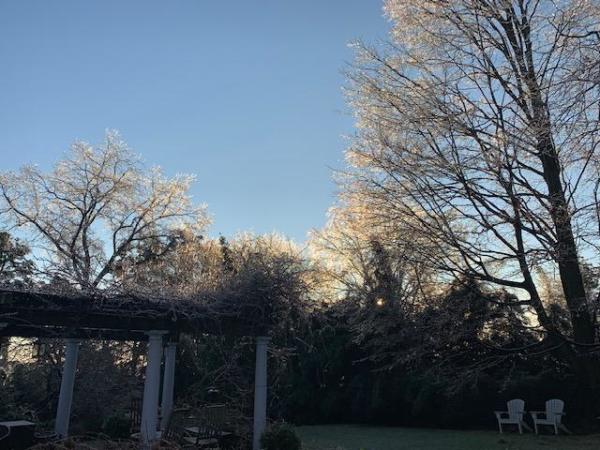
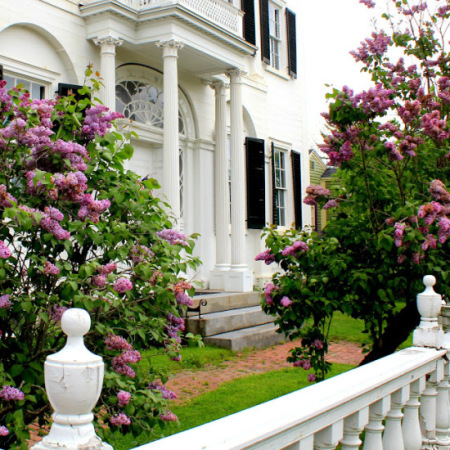
Photo via our internet friend Muffy. I sort-of wish I had a New England home like that, but I am a happy American nevertheless, with our lilacs in sweet bloom.
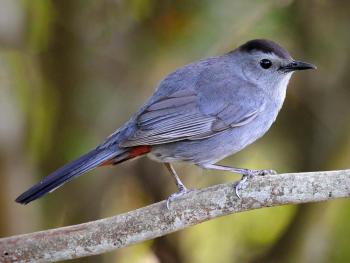
The bird he refers to is the Catbird. Yesterday morning before church I heard a Rose-Breasted Grosbeak calling, and looked around, Nope. It was a Catbird. Mimic thrush. Fooled me.
The world is charged with the grandeur of God. It will flame out, like shining from shook foil; It gathers to a greatness, like the ooze of oil Crushed. Why do men then now not reck his rod? Generations have trod, have trod, have trod; And all is seared with trade; bleared, smeared with toil; And wears man's smudge and shares man's smell: the soil Is bare now, nor can foot feel, being shod.
And for all this, nature is never spent; There lives the dearest freshness deep down things; And though the last lights off the black West went Oh, morning, at the brown brink eastward, springs Because the Holy Ghost over the bent World broods with warm breast and with ah! bright wings.
I found a lengthy word with a non-Russian ending, unwittingly, inside a children’s storybook, and turned away from it with a strange kind of shudder.
That word contained the writhing of mysterious passions: The growls, the howls, the whistles and the senseless visions, assassinated horses’ vitreous eyes,
the sinuous streets, the evil-auguring constructions, a man, incarnadine, prostrate upon his back, the bestial motions of somebody’s avid hands!
And, once upon a time, how sweet I used to find it to read of funny rabbits who would dance in spring with guinea pigs on stumps beneath the moon.
But now the fateful word above my childhood tales, stormlike, has rushed! Gone is their old simplicity; and terrifying thoughts, during the doomful nights,
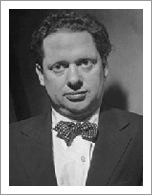
Written as prose, A Child's Christmas in Wales might as well be verse. It begins thus:
One Christmas was so much like another, in those years around the sea-town corner now, out of all sound except the distant speaking of the voices I sometimes hear a moment before sleep, that I can never remember whether it snowed for six days and six nights when I was twelve or whether it snowed for twelve days and twelve nights when I was six. All the Christmases roll down toward the two-tongued sea, like a cold and headlong moon bundling down the sky that was our street; and they stop at the rim of the ice-edged fish-freezing waves, and I plunge my hands in the snow and bring out whatever I can find. In goes my hand into that wool-white bell-tongued ball of holidays resting at the rim of the carol-singing sea, and out come Mrs. Prothero and the firemen...
The whole piece can be read here but, better yet, you can stream Thomas reading it here. (19 minutes)
It is winter in California, and outside Is like the interior of a florist shop: A chilled and moisture-laden crop Of pink camellias lines the path; and what Rare roses for a banquet or a bride, So multitudinous that they seem a glut!
A line of snails crosses the golf-green lawn From the rosebushes to the ivy bed; An arsenic compound is distributed For them. The gardener will rake up the shells And leave in a corner of the patio The little mound of empty shells, like skulls.
By noon the fog is burnt off by the sun And the world's immensest sky opens a page For the exercise of a future age; Now jet planes draw straight lines, parabolas, And x's, which the wind, before they're done, Erases leisurely or pulls to fuzz.
It is winter in the valley of the vine. The vineyards crucified on stakes suggest War cemeteries, but the fruit is pressed, The redwood vats are brimming in the shed, And on the sidings stand tank cars of wine, For which bright juice a billion grapes have bled.
And skiers from the snow line driving home Descend through almond orchards, olive farms. Fig tree and palm tree - everything that warms The imagination of the wintertime. If the walls were older one would think of Rome: If the land were stonier one would think of Spain.
But this land grows the oldest living things, Trees that were young when Pharoahs ruled the world, Trees whose new leaves are only just unfurled. Beautiful they are not; they oppress the heart With gigantism and with immortal wings; And yet one feels the sumptuousness of this dirt.
It is raining in California, a straight rain Cleaning the heavy oranges on the bough, Filling the gardens till the gardens flow, Shining the olives, tiling the gleaming tile, Waxing the dark camellia leaves more green, Flooding the daylong valleys like the Nile.
After great pain, a formal feeling comes – The Nerves sit ceremonious, like Tombs – The stiff Heart questions ‘was it He, that bore,’ And ‘Yesterday, or Centuries before’?
The Feet, mechanical, go round – A Wooden way Of Ground, or Air, or Ought – Regardless grown, A Quartz contentment, like a stone –
This is the Hour of Lead – Remembered, if outlived, As Freezing persons, recollect the Snow – First – Chill – then Stupor – then the letting go –
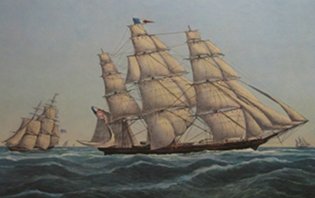
The Building of the Ship (c 1850). Yes, about boat-building, skill and craft, but also a metaphor about the American nation.
It begins:
"Build me straight, O worthy Master! Stanch and strong, a goodly vessel, That shall laugh at all disaster, And with wave and whirlwind wrestle!"
The merchant's word Delighted the Master heard; For his heart was in his work, and the heart Giveth grace unto every Art. A quiet smile played round his lips, As the eddies and dimples of the tide Play round the bows of ships, That steadily at anchor ride. And with a voice that was full of glee..
The rest of the delightful saga is below the fold -
You want to know how I spend my time? I walk the front lawn, pretending to be weeding. You ought to know I'm never weeding, on my knees, pulling clumps of clover from the flower beds: in fact I'mlooking for courage, for some evidence my life will change, though it takes forever, checking each clump for the symbolic leaf, and soon the summer is ending, already the leaves turning, always the sick trees going first, the dying turning brilliant yellow, while a few dark birds perform their curfew of music. You want to see my hands? As empty now as at the first note. Or was the point always to continue without a sign?


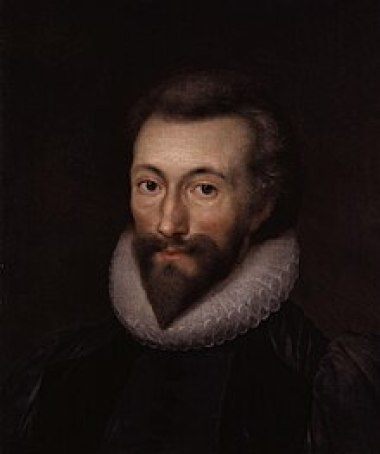 John Donne (1571-1631)
 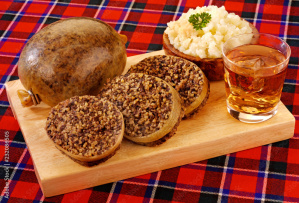 Address to a Haggis
 Written as prose, A Child's Christmas in Wales might as well be verse. It begins thus: