We are a commune of inquiring, skeptical, politically centrist, capitalist, anglophile, traditionalist New England Yankee humans, humanoids, and animals with many interests beyond and above politics. Each of us has had a high-school education (or GED), but all had ADD so didn't pay attention very well, especially the dogs. Each one of us does "try my best to be just like I am," and none of us enjoys working for others, including for Maggie, from whom we receive neither a nickel nor a dime. Freedom from nags, cranks, government, do-gooders, control-freaks and idiots is all that we ask for.
Failing to confirm a hypothesis is a crucial part of scientific
discovery. But the journals aren’t interested in publishing papers that
document a failed experiment. They only want papers that announce
successful results—the more headline-worthy the better. So that becomes
the singular goal of any ambitious researcher.
In the lecture halls of the University of Edinburgh Medical School
in the late 1800s, students witnessed something extraordinary. A man would walk into the room. He hadn't spoken yet. He hadn't been examined. But before he could utter a single word, Dr. Joseph Bell would look at him — really look at him — and begin to speak. "You've
been working as a cobbler," Bell would say. "Recently in the north of
England. You served in the military. A Highland regiment, perhaps a
bandsman." The patient would stare in disbelief. And Bell would explain. "Notice
the way he walks — a slight limp. The calluses on his thumbs and
forefingers? That's from holding leather tight while stitching. The clay
on his boots is reddish — from the golf links on the south side of
town. The tan line on his wrist suggests he recently wore a watch —
military men wear them. His posture is upright, disciplined. He carries
himself like a soldier. And the calloused fingertips? Those are from
playing a brass instrument." The room would fall silent. Then the patient would nod. "That's exactly right, sir." This wasn't magic. This was Dr. Joseph Bell.
Born in Edinburgh on December 2, 1837, Joseph Bell came from a family of surgeons. His great-grandfather, grandfather, and father were all Fellows of the Royal College of Surgeons of Edinburgh. Medicine was in his blood. Bell attended Edinburgh Academy, then enrolled at the University of Edinburgh Medical School at just sixteen. He graduated in 1859 with his medical degree. He was brilliant. Driven. And he possessed an unusual gift — the ability to see what others missed. By his late twenties, Bell was a lecturer in surgery. By his thirties, he was senior surgeon at the Royal Infirmary of Edinburgh. He edited the Edinburgh Medical Journal for twenty-three years. He served as President of the Royal College of Surgeons of Edinburgh. He founded Scotland's first nursing training program. He was Queen Victoria's personal surgeon whenever she visited Scotland. But it wasn't his surgical skill that made him legendary. It was his mind.
Bell taught his students that observation was everything. "Use
your eyes," he would say. "Use your ears. Use your brain. The patient
is a book written in a language you must learn to read." He believed that close observation was the key to accurate diagnosis. That the smallest details could tell you everything you needed to know. He would pick strangers from the hospital and, in front of his students, deduce their entire lives. A woman walks in. "You've
been working as a domestic servant," Bell would say. "Recently in a
household with coal heating. You've spent time scrubbing floors. You're
right-handed. And you've recently been to Fife." The woman would gasp. "How did you know?" "The
coal dust under your fingernails. The roughness of your knees. The
slight enlargement of your right hand. And the red clay on your dress —
that's from Fife." He was right every time. His students called it miraculous. Bell called it science.
One of those students was a young man named Arthur Conan Doyle....
Pulmonary emboli, from from deep vein clots, are serious if not fatal.
Because aspirin reduces platelet aggregation, it would seem sensible to take 81 mg before long sedentary periods. However, studies do not confirm that.
I do not need or use GLP-1 medicine, but lots of people do. It works mainly by reducing appetite and food intake, but does other useful things too.
I am a semi-fan of Creatine. Theory is that this stuff (found naturally in red meat and sold as something for muscle-building support) enhances ATP production in muscle so that muscle can be stressed more effectively.
It might be placebo effect, but I use it. I am not a body-builder.
Before saying anything else, let's be clear that the diagnosis of Autism, or Autism Spectrum, has changed and expanded so much in the recent decade that far more kids have been caught in that net.
The "epidemic" is caused by changes in diagnostic criteria. Maybe, more attention to mental differences.
Even so, given the complexity of the human brain and the complexity of brain development, it's a wonder to me how often it works out sort-of ok - but never perfectly.
It was not long ago that being pudgy or having a bit of a gut signaled prosperity, and leanness signaled lower class. Now it's the opposite. With incredible food abundance, and with obesity always in the news, funding for nutrition-related studies has grown. So now we know a lot more about how insulin works and about how the three food categories (fats and oils, carbs, and protein) are handled by the body. We are also learning about how hunger and satiety work. It's quite interesting but complicated.
These are "First World issues." In our world of nutritional abundance, recreational, social, and emotional eating, and the constant temptation of food porn, "hunger" often does not denote a need for nutrition except for the skinny, and satiety is often over-ridden by habit, speed-eating, stomach-stretching, delicious foods, sugar-and-carb dosing, and insulin-resistance. That is what it means when overweight people, who have no pressing energy needs at all other than water, vitamins, and minerals, eat hungrily two or three times a day. We term that appetite "false hunger" not because the appetite is not subjectively experienced but because appetite has, for them, disconnected from nutritional need and satiety signals (which are very slow to go into effect). That luxury used to be only for the wealthy.
It's like the flip side of anorexia. Anorexia nervosa is famously difficult to ameliorate, but it is not too difficult for most pudgy or fat people to re-set their bio-psycho-social food-o-stat if they want to. For starters, that entails small portions, plenty of protein to satisfy the hormones, and very slow eating so as not to short-circuit the awareness of the moment at which "That's enough to sustain me, because I don't feel hunger anymore." That way, the "Eat 'til I'm filled or stuffed...now I'm stuffed" effect never has to happen.
In the Western world, "sufficient" can be the stopping point, not "filled." Except Thanksgiving, when feeling ill from getting stuffed with stuffing is expected.
Being too scrawny, with underdeveloped muscle and bone, is life-limiting and unhealthy, but not as life-limiting as carrying excess fat around with its lengthy list of associated ailments. There's no need to carry it on your body, because there's a pizza joint on every corner to prevent sudden death from starvation. Most people, fortunately, make themselves sensitive to satiety signals most of the time so most active adults are neither significantly under- or over-weight.
Obviously, little of this applies to most children and adolescents.
What has occurred in the last week, for me, has been significantly bad. Nothing measured or caught for medical worseness - just that radiation on your brain for 6 weeks slowly causes growth in skull brain reduction in the region after about 4-5 weeks as language and memory slows due to expansions of brain from this. Over time, this will reduce. It ended all yesterday and I headed down to FL to live with my in-laws who were very grateful to offer themselves to me. They are in their late 87s and in wonderful shape than my own parents - and they have been AMAZINGLY HELPFUL helping me with my word members and working through when I hit memory or language slowdowns. As an FYI, over 32 years of married to their daughter, I have gained a great deal of love and support for these people, even as both my parents and one stepmother remain alive, they are simply not capable of keeping up with me at all the way my in-laws have. I owe them great love and support for their effort and support.
Aw it's so hard lately to get anything done. Took 2 weeks to prepare taxing prep and set with the accountant. Finally completed it all by 4/5 but required TONS of working to prep.
We won't be getting much home, but we did discover several things we'd lost along the way. The only thing I'm still struggling with is why my tax accountant won't announce the $12,000 stolen from a previous recruitment account where someone had figured out a path into it - and FBI and local Police have that information on papers. But supposedly it's not available as a write off for payments so he won't claim this. I do not understand how or why the government wouldn't allow people to claim stolen income loss. It's remarkable or he's bad - but he's very good and sent the data. So I'm not sure what I need to do.
I am done radiology and chemo on 4/15. By 4/22 I'll be back at work at my office again for at least 2 week, then a vacation set first full week in May down on Bahamas...so I am looking forward to the return with work again and my new treatment.
I received yet ANOTHER article by a Canadian doctor doing a lot of cancer treatment using Ivermectin. I do not know 100% that the link from Covid Vaccines is playing the role - but I have been reading more and more supporting this potential that is NOT being reviewed or studied. So much so, several AI sources were removing legitimate articles making the claim - I found this odd and sent AI restrictions and was told it was designed to end "lies" yet none of these were proven as lies. This latest one further leads a bit to options - I am NOT SAYING THESE ARE TRUTHFUL FIXES and real. But they are highly supportive so far if a larger group will begin to look into and address all this. Here is an example of someone is trying to utilize - I am not selling this as 100% legitimate. I am saying it is possible and is not being reviewed. My view is many potential options are deliberately being ignored and quieted.
I am getting healthier, however, as radiology ends down I am slipping to some misspelling and word shortages from time to time. My apologies. It was warned by my doctor and my speech therapy treater. It's not long lasting - just temporary short issues of brain intact from radiology. I have had up and down days. The main item - one great day with trips in to NYC to see friends for 5-6 hours, then very tired and troubled the next day...
Reality is my meeting with my Pastor was very nice and our conversations have been growing. I do not fully buy into my Catholic past, but it is still very good and how I grew up. I'm not specializing overall for myself. I am wide open - and I will handle well shared comments and views.
I wish I could go out and do more. I will remention that my plan is to buy tickets for the English Beat and Adam Ant concert tomorrow. Hoping I continue to feel well enough. As I mention, I had quite the list of titles from my visit to several concerts in 1983 in London. I do miss that era. I covered quite a bit back then...so I will cover many now if I can.
By the way - reminder - view "Defending Your Life" - one of my favorite Albert Brooks great ones. I feel it treats how I approach my own situation now...
I mentioned a friend who died of a similar version of mine from 2021. We did learn her diagnosis in April 2020 and lasted 17 months. She was great, hilarious and deeply involved in many ways. The downside may have been related to her husband. It is not good to learn. He was a great guy. But it seems he started out on board and deeply involved, eventually met with some hard times and by the end had removed himself from many of the details. Based on my experience, I believe I can see how it may develop over time. He stepped out entirely of the process. The victim, our friend's, mom and sister tossed themselves in for support and assistance and guidance. She held up extremely well with their assistance. Her mind was intact all through, but she could not have surgery at all (I can to some small degree).
The upside was lots of digging and travel to find conversations. The downside, similar to mine is that nothing is happening. Nothing available. She even gave up the chemo and radiation for two reasons, it set her off badly and she did not feel better. Thankfully, MY version of this has, early on, been a bit better. There are downsides for me which I need to work on from time to time. For me, this past week in particular, heavy emotional shifting occurs on certain days for short times. Mrs. Bulldog and I have had some heavy fighting - but Mrs. Bulldog is a master and takes on, managing the hyper issues - she is a saint. After moments where the chemo makes me emotionally aggressive, I do manage to resolve. It takes time and effort. The real problem is not often, but the problems happen on both sides. Often she is the hero, but sometimes it resolves around a decision to listen then engage separate from conversation - completely misunderstanding my position well, and it leads to problems from time to time. It can be unfair of me and it may be too much at times. It is, no doubt, a requirement for me to remember to resolve and address more effectively. In fairness, remember I can't always control things as fairly or evenly as I can in a momentary discussion about our medical and/or conversational paths forward. Sometimes I'm not wrong to get upset over poor decisions - sometimes people just assume things "as is" where it may require help or time. Other times it's my fault and I have to walk it all back well. I'm deeply sorry when that happens.
Listening to the friend and her stories was distressing. I'm sure she had similar situations. Which may have led to her husband's eventual stepping aside. It's not easy, but I'm lucky to have someone who isn't stepping aside. So I am learning from our friend's situation. She, unfortunately, began to see the mental loss around 16 months in. She suffered a stroke in the final month and held for 4 days afterward. I have deep hopes I can hold longer and find more opportunities. Reality is speaking openly, though, and that is important to stay on top of effectively. I am blessed from my family in many ways. And many friends.
I feel awful for our friend who passed and everything which occurred along the way. I know I make errors at times to my family while taking the medication and how it hits my emotions after some time passes. But I do shift back. I try to avoid it as much as I can. I can't imagine what our friend went through and I bless her and her husband (who passed several years later) for missing opportunities. I want to avoid that as well as I can, and I will try to as much as I can.
While spending time with my brother, we covered many topics. Sports mostly, management of friendships, trips, etc. He is aware my time is limited, and we're looking for paths froward to enjoy what time we have together.
That said, we had one issue in particular. It now may involve most of the reading I've done this past weekend and how some things are poorly being covered well.
First, I have two articles (which I will not post here because until I review them with doctors I won't claim this to be true, but I will explain why I believe it) which state the CDC blocks testing which has potential opportunity for several reasons. Mainly, CDC leans heavily into relations and trials pushing work and medical properties from Pharmaceutical companies. I have, indeed, seen that extensively with the trials I've been reviewing. It is ALL CDC promoted or approved. Secondly, a friend recently complained about CDC relationships regarding its pharmaceutical relationships and its efforts to block things which fail to raise money or results with pharmaceuticals preferred and/or managed by CDC and/or politicians. She gave me a specific example (which I cannot name) where she shifted her son to a different treatment that was NOT CDC approved for diabetes, and he had tremendous gains and improvements as a result using treatments from non-pharmaceutical doctors and medicine. Sometimes these stories are questionable, but hers is 100% accurate and has been mentioned often - while the CDC often tones it down and hides it.
Secondly, I have now found 5 websites I need to review with my doctors. One from a commenter I have wished thank you to - though I suspect the link isn't going to be helpful based on my reading, it is a doctor showing massive cancer successes - always worth conversations even if I may not be coverable. Several other websites were shared by other friends to me which have new treatments, again with the CDC opposing for no clearly evident support, that has shown some benefits in small trails seeking larger testing. It uses non-pharmaceutical medicines which have shifted to broader availability and easily attainable prescriptions AS WELL AS additional treatments. In particular, one is not seeking trials, but is a pro-methylation support and growth for HEALTH AND FOOD to engage improved methylations in people's bodies which often show declines. The doctor writing casually mentioned some cancers show non-methylation that may find results but did not mention testing. It utilized several B vitamins as well as several others to assist in methylation and protein improvement via DNA, for general people. I found this very interesting...yet never mentioned by any doctor.
While I wish it was something far more open about survival longer than expectations (which anything is possible, however unlikely), I got some interesting information. One person shared a book in comments - thank you! I have ordered it.
To me, it's a winner. Neurosurgeons who know patients with limited times and low expectations and how to handle it. I consider that a blessing.
Oddly, I received a call early today. From a bit of a distant friend of a friend from Cincinnati. My friend had lived there before having to move to California (where she hates it now and blames Gavin Newsom as an absolute horrific holder of an office that somehow keeps winning and having press supporting his absolute horror, leading her to leave). That oddness of California aside, my friend introduced us to her friends in Cincinnati. While my son attended college in Miami, Ohio, I often had rooms in Cincinnati and would meet them locally for great times. They were wonderful people.
There have been at least 10 calls or meetings with my doctors and learned several issues. It isn't that doctors withhold information, but sometimes trials and treatments are described certain ways to push for particular outcomes. In my particular situation, there are, literally, very few of great benefit. As a result, one we had originally signed up for early, we quickly dropped out of taking part as a member. We learned a lot about no outcomes at all for my particular issue. We also learned about significant reduced health as part of it and a switch in my chemo drugs - which have significantly lower results. So we dropped out and switched to the original chemo for sllightly better near term results. We shall see.
I also had to attend a speech therapist from the oncologists themselves. I took several tests and ran several case studies for an hour and a half. I found my math, history and speaking skills were better than my graduate studies. I also found my ability to remember music, movies and certain names of known actors or singers to be sufficiently less - but also that was common among people my age. Another test, which required my naming several word categories within a minute to be well done - except for one. Words starting with the letter "M" and no names, did well for 40 seconds and stalled as one word dropped out of my head and I was dragging behind to spell it out and remember it. This identified a very high area to help improve my mentality where I have stalled. That said, she asked many business and corporate questions which were not stalled or slow at all. She was rather shocked by this in media as I exposed several concerns with journalists I'd had issues with - and they were backed up in her data, as well as my ability to describe a lawsuit I had closed with a previous employer, as well as my description of several previous depositions which I'd taken part of and my ability to not only remember them (though dates I doubt I could provide) I did know what was covered.
A giant Thank You for all of the good, caring, and careful work you do. Not just for the ailing person, but for the family. My lad, who knows about these things, half-jokes that hospice care is the best medical care in the US, and morphine is still medicine's greatest gift besides antibiotics. Morphius - the Greek god of dreams and sleep.
We lost my shanachie father-in-law this weekend after his long, cheerful, often joyful life, and the hospice people have been amazing. Never in a hurry either. A blessing.
Fortunately for our family, there is one new child waiting to be born to carry on, to carry on.
Setting aside my day with my brother on Tuesday for four hours. I'll just start with it was great walking and exercise, lunch at a diner that was great, and just 4 hours of talking about his experience with people who have had what I now have and what we felt was good to cover. Personal. Religion. History and Podcasts. Sports in depth. But mostly about my situation and logical outcome which will be reached at some point. All really nice to have and will share some another time.
My visit to Memorial Sloan Kettering on 53rd St in NYC was expected to just be a part of one conversation and possibly 2 others with one at Duke and one in Florida. After four hours, we made a decision and I will explain a bit.
First, my current group will handle radiation and chemo here near the house. That was set - and 2 weeks before starting. Now the radiation will continue here, but the chemo we learned and signed for at MSK is slightly different and will involve a new test with several options and groups and some information completion. It's a new trial and the doctor said they could collect my data and health and potentially (slim possible rejection) sign me up. As of now - high probability to join and take part. Mostly needing to see results and my ability to share, speak and keep notes. So it's engaging. That does need a level of intelligence they tested (I scored really high with their process and engagement) and a willingness to engage. I was all for trying things, which they smiled about. My current doctor, who has several potential tests but several weeks off, will be sidelined while I join this. Both groups work separately but share information and conversation as necessary. This is a learning chance!
Second, doctor and nurse were blatantly open. What is the reality. My best shot for now - I have a non-Methylated Glio Blastoma which is one of several different kinds of the same issue. Mine is very specific with a lot of downside potential over time when it comes to opportunity. They were very open to "enjoy life and get the most out of what you want, even if it includes cutting out of testing or trials." They support travel, learning, having fun. "Enjoy your life and get the best you can." I said I will, but I want to learn more, too and potentially help others. They smiled and loved my engagement and willingness.
Third, health and intelligence top notch! Nurse kept testing several times. No issues. Now approved to drive if I want. She recommended sports and gym again. Just got to let the surgical swelling on the left brain continue to decline which is slowly happening but maybe 2 more weeks. It doesn't hurt much. Just swollen and feels odd.
Fourth, GREAT BURGER at PJ Clarke's in NYC. A CLASSIC. Always has been. I don't know why but man that was so darn tasty. Food is still REALLY delicious.
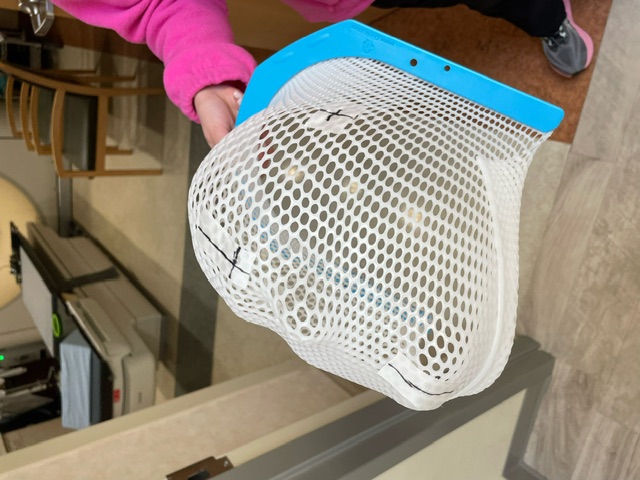
Fifth, had my new mask for radiation set today at the hospital. After six weeks I get to keep it - kind've new artistic item. See attached!. It's a pin which radiates different parts of the head over 20-30 min each day starting 3/1.
Today, just lots of sleepiness. Got 6 hours last night. Got 3 hours today. Will probably get another hour before bed. LOL. No idea why just really dragging suddenly.
Still having lots of texts and phone calls, though - so all 100% positive and looking for fun.
For anyone not interested. Let me start with "I'm sorry if you don't want to read this." I know everyone varies on how these stories develop and take place. It can be boring or time consuming and even annoying. So my apology if it is for you in some way. That said, I'm finding it all really interesting to talk. Also, oddly, suddenly boring from moment to moment. As we spoke to the doctor, everything was great and suddenly he and the nurse began telling my wife and one son some information regarding the test and after 10 minutes he looked at me and asked if I was ok. I said "Yes, but now that I know I get to engage this soon, the data is boring me. I'll leave that to them and they can handle all that. Me? I want to get started and I don't care." He laughed and said "lots of ways to approach this."
Was suddenly and surprisingly called to the oncologists a week earlier than they had planned. 4 hours with 5 different doctors and the surgeon who removed the staples from my head. Pretty good overall after 9 days.
He was very happy and positive with that. Says my speaking was excellent. I was surprising him well for health - recommended I go back to the gym regularly already. My intelligence? Very, very high since his surgeries on this topic often have far more concerning outcomes from the people treated. I was said to be shockingly good. But he did recommend some realism and expectations. Realistic is 18 months of probability. That's the likelihood. Not essentially how it will happen. Just pretty standard.
I mentioned I had 2 friends who i have - Glio Blastonoma - which both lasted 18 months. It's not assured, since there are now several things we can try and test. I said "I'm 100% in for anything immediately and I expect the best!" They like my attitude! But they also asked me to be a realist. I said fine - I've done that already. But I'm not going to just give up too easily. I'll expect more and try more for whatever can happen and expect!
I can head back to work already, technically. I will shift to 1 day a week for 6 weeks for now. After 6 weeks of radiation and chemo, I have to adopt some other tests and treatments that are merely "looks at what MIGHT help a little." I can work while having that. One will require shaving all hair off and adopting some electronic treatments long term. There are other things which I may engage, as well.
But the doctors, as happy as my push for happiness, positiveness, openness and anything good - they loved that I wasn't crying or upset. They were also "Let's just be open too about what reality seems to indicate."
I replied "fine - my brain is actually talking to me - and I'm fine with reality." They asked what I was being told by the brain. For the first time I repeated things that it keeps saying. They said it's correct - and that it's not terrible to expect even if the brain speaking may be driven by medication....doesn't mean the brain is wrong.
It rarely has been, of course, which is why I always loved writing and pushing attitudes some people even today are disgreeing with me about (incorrectly mostly).
So that's what we know for now. We shall learn more.
Boys came home, we've had some talks. We are being open and realistic. It will all be very, very hopeful and I am pushing myself hard already!
All the best and while 18 months will be expected, I'll love whatever we have. Always the best!!!
By the way, peanuts are, of course, not nuts even though they look like nuts. Like so many foods that the world loves, peanuts originated in Central America.
I've had a couple of surgeries in my life, but had never spent a night in a hospital until last week: 5 days in there. Even in a very attentive and kind hospital it is a strange, unpleasant - and disorienting - experience. Feeling like a pin cushion is the least of it.
I'd be interested in other peoples' experiences.
Things I learned:
- Rules about your restaurant doggy bag: Heat to 165+ degrees before eating it, and throw it out after 24 hrs. Our new rule: No more doggy bags at all (except steak) which is a drag for me because I have not finished a restaurant meal in a decade. Typical food-poisoning is Salmonella, but I got Campylobacter (which is typically minor but not in my case). Besides fatigue and constant diarrhea, my electrolytes became dangerously imbalanced which is what concerned the docs: Potassium mostly. Plus IV saline to combat the dehydration.
- When you are sick as s-, you don't necessarily appreciate how ill you are because it affects your mental clarity. I had to fall on the floor from weakness + dizziness due to dehydration to realize this was not nothing.
- Being in hospital feels like confinement (is confinement) unless you feel too terrible to get out of bed. Plus the hospital gown makes you feel (and look) like an invalid: "How are we feeling this morning? Did we have a BM?"
- A "Clear liquid" diet is the worst thing. 3 times/day: Decaf tea, jello, ginger ale (which is ok), lemon ice (which I hope to never see again). Finally got a nice nurse to sneak me fresh coffee from the nursing station.
- How to fix an IV pump yourself when it beeps an obstruction.
- A regular Med/Surg floor at my place had 4 units, about 20 patients/unit. A unit has a Charge Nurse, 4 RNs, 4 CNAs (Certified Nurse Assistants) and a clerk. The RNs work 12-hr shifts for 3 days (7 -7), then 4 days off unless they want to fill in for others. I had a private room, thankfully. The hospital docs make rounds any time before 1 or 2 pm.
- When a patient dies it is dealt with discreetly. Happens all the time, too.
- Can you sleep normally in a hospital? Nope, even with sleep meds.
That book is written for the general public. Mind-boggling. It is a wonder that it all works so well most of the time. Nothing man can make works as well, for so long. With health, I tend not to be overly curious about why things go wrong, but to be amazed about how anything ever goes right.
I once laughed at a M*A*S*H episode in which a British fellow was commenting on his military's focus on foot hygiene. It was amusing at the time, but over the years I've largely ignored my feet. To my dismay.
I was just over 30 when I had both feet operated on for bunions. That was a vast improvement, but it more or less ended my competitive volleyball days.
I was just over 45 when I suffered severe back trauma which I learned was related to tight hamstrings, and recently learned that was related to my feet.
At any rate, I had one bunion operated on again, it was a big operation, when I was 55. Today, as I inch closer to 62, I have a host of foot problems. Not good for someone planning on hiking the Camino de Santiago in the next few years.
My new podiatrist had nothing good to say about the previous operations. He explained to me they were improper diagnoses of the situation and now there's not much chance any additional surgery will provide relief. He also pointed out something I'd known about but never took seriously. I don't use orthotics.
He did a scan, got me some, and I've got to say my feet feel much better. Not 100%, but at this point I'll take any improvement.
I also now spend a lot of cash for properly-fitted sneakers. I always figured if they fit, they're fine. Over the last year I've learned to take that a little more seriously. Hokas are the new brand - I'll let you know when I get them if they're "all that". At least you can get them sized for width, which is critical for me.
Take care of your feet. Don't ignore them or put off any care the way I have. Big mistake, and fixing what's messed up isn't easily reversible at my advanced age.



 Part 1